ERP vs SAP? If you’ve explored business technology or enterprise software, you’ve probably heard the terms ERP and SAP. These terms are often used together, which leads many people to think they mean the same thing.
However, that’s not entirely correct.
While ERP and SAP are related, they represent two different concepts.
For students, professionals, and businesses entering the world of enterprise technology, understanding ERP vs SAP is essential. It helps remove confusion and gives clarity about how modern businesses manage their operations.
In this guide, you will learn:
- What ERP actually means
- What SAP is and why it is so popular
- The key differences between ERP vs SAP
- How companies use these systems
- Career opportunities related to ERP and SAP
Let’s start with the basics.
What is ERP?
ERP stands for Enterprise Resource Planning.
Simply put, ERP is a type of software that helps companies manage their daily business operations using one integrated system.
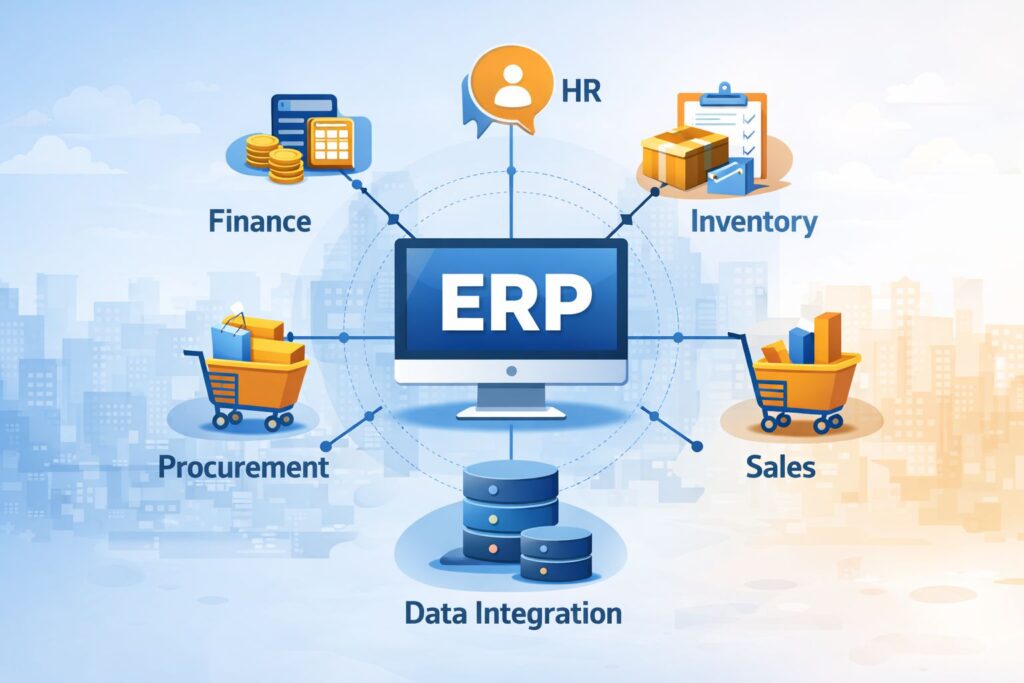
Most organizations have multiple departments such as finance, HR, inventory, sales, and procurement. Traditionally, each department might use separate software tools. This often results in scattered information and poor communication between teams.
ERP systems solve this problem.
They bring all departments together into one centralized platform where data can be shared easily.
With ERP software, businesses can manage multiple processes from a single system, making operations smoother and more efficient.
Common Business Functions Managed by ERP
ERP systems typically support several core business activities, including:
- Financial management and accounting
- Inventory management
- Human resource management
- Supply chain operations
- Procurement processes
- Sales and customer relationship management
Because all departments use the same system, information flows more smoothly across the organization.
A Simple Example of ERP in Action
Let’s look at a simple example.
Imagine a customer places an order with a company.
Once the order is received, several departments become involved:
The sales team records the order.
The inventory team checks product availability.
The production team prepares the product.
The finance department generates the invoice.
With an ERP system, all these processes are connected. Each department can access the same data in real time.
This integration makes operations faster, more accurate, and more efficient.
What is SAP?
Now that we understand ERP, let’s talk about SAP.
SAP is not a category of software like ERP. Instead, it is a company that develops ERP software and other enterprise solutions.
The name SAP stands for Systems, Applications, and Products in Data Processing. The company was founded in Germany and has grown into one of the largest enterprise software providers in the world.
SAP offers many business solutions, but its most well-known product is SAP ERP.
To simplify the concept:
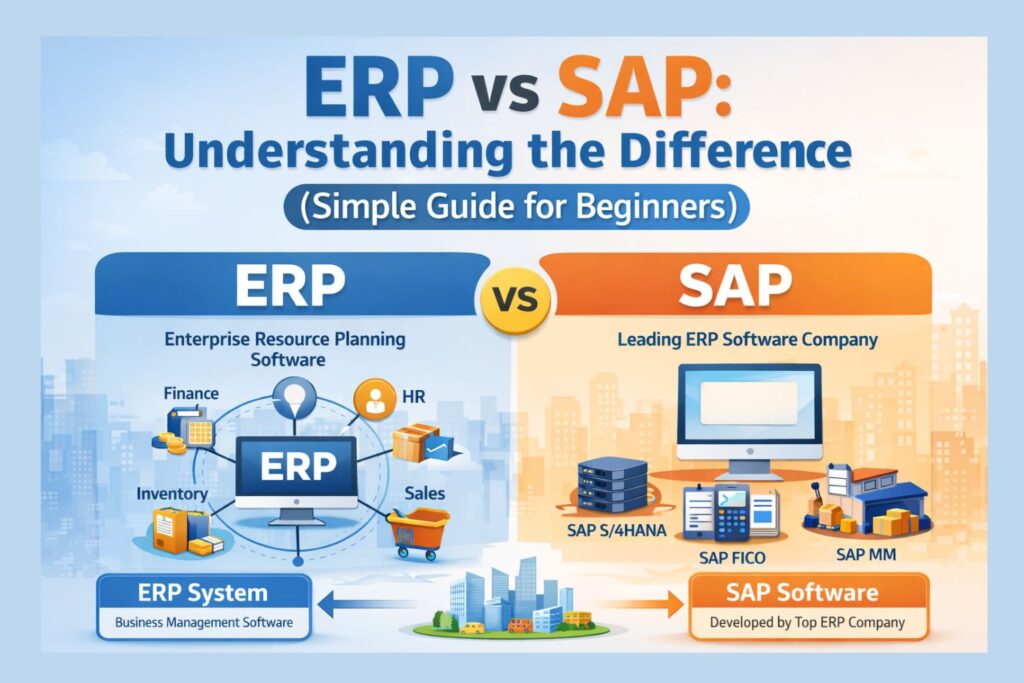
ERP is a type of software used by businesses
SAP is a company that creates ERP software
This is why people often search for ERP vs SAP, even though SAP is actually a type of ERP system.
ERP vs SAP: The Key Difference
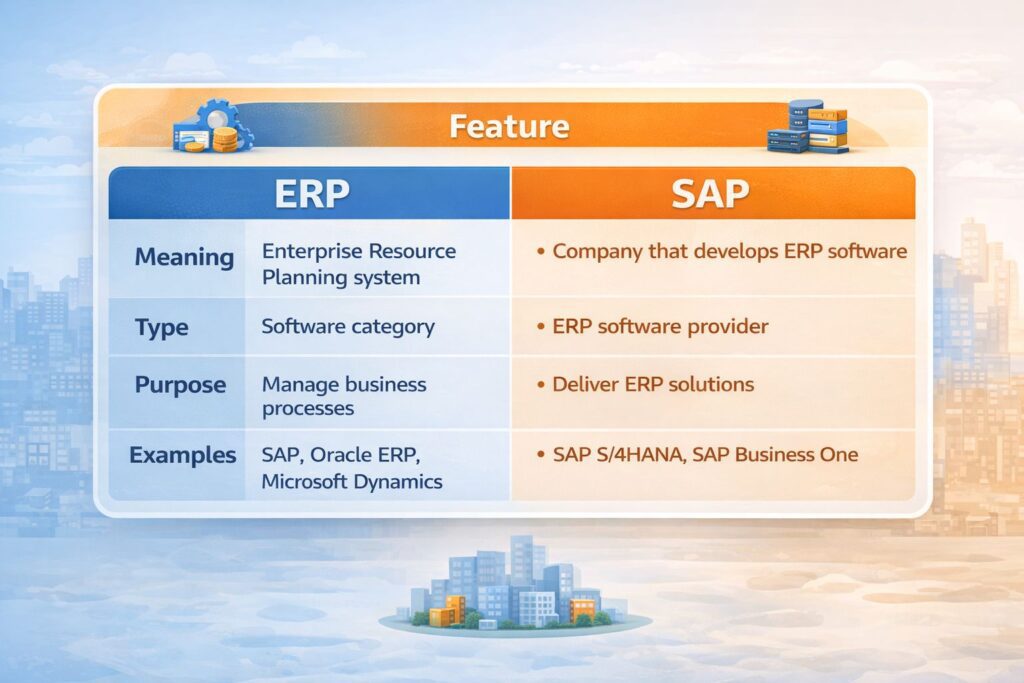
Different Types of ERP Software
Although SAP is very popular, it is not the only ERP platform available.
Several technology companies develop ERP solutions for businesses of different sizes and industries.
Some well-known ERP platforms include:
- SAP ERP
- Oracle ERP
- Microsoft Dynamics
- NetSuite
- Infor ERP
Each ERP system offers unique features and capabilities depending on business needs.
However, SAP is often considered the industry leader for large enterprises because of its strong integration and scalability.
Why Businesses Use ERP Systems
ERP systems have become essential tools for modern organizations. They help companies improve efficiency and manage complex operations.
Here are some of the main benefits.
1.Better Data Organization
ERP systems store all company data in one central location. This helps teams access accurate information quickly.
2. Increased Efficiency
Automation reduces repetitive tasks and saves time for employees.
3.Better Decision-Making
ERP software provides real-time reports and analytics that support smarter business decisions.
4.Lower Operational Costs
By improving workflows and reducing manual processes, ERP systems help businesses save money.
5.Easier Business Growth
As companies grow, ERP systems help them manage larger workloads and more complex operations.
Because of these advantages, ERP systems are widely used in industries such as manufacturing, retail, healthcare, finance, and logistics.
Why SAP is So Popular
Among all ERP platforms, SAP has built a strong reputation worldwide. Many large organizations rely on SAP to manage their operations.
Here are some reasons why SAP is widely used.
- Strong Integration
SAP connects multiple business processes into a single system.
2. Industry-Specific Solutions
SAP provides customized solutions for industries such as:
- Manufacturing
- Retail
- Banking
- Healthcare
- Logistics
3.Global Adoption
Thousands of companies across the world use SAP ERP.
4.Advanced Technology
Modern SAP platforms include powerful tools such as real-time analytics, cloud integration, and automation.
Understanding SAP Modules
One of SAP’s biggest strengths is its modular structure. Instead of implementing the entire system at once, companies can select specific modules based on their needs.
Some commonly used SAP modules include:
- SAP FICO – Financial accounting and controlling
- SAP MM – Materials management and procurement
- SAP SD – Sales and distribution
- SAP HCM – Human resources management
- SAP PP – Production planning
These modules work together to support different departments within an organization.
Career Opportunities in ERP and SAP
As more businesses adopt ERP systems, the demand for skilled professionals continues to grow. Organizations need experts who can implement ERP systems and optimize business processes.
Common ERP Career Roles
Professionals working with ERP systems may take roles such as:
- ERP Consultant
- ERP Analyst
- Business Process Consultant
- ERP Project Manager
Popular SAP Career Roles
SAP specialists typically focus on specific modules. Some common roles include:
- SAP FICO Consultant
- SAP MM Consultant
- SAP SD Consultant
- SAP Functional Consultant
- SAP Technical Consultant
Because SAP is widely used by large enterprises, many professionals choose to specialize in SAP.
ERP vs SAP: Which One Should You Learn?
If you’re considering a career in enterprise technology, your choice depends on your career goals.
You may want to learn ERP concepts first to understand how businesses operate.
Later, you can specialize in SAP modules to build advanced technical expertise.
Many professionals follow this path because it provides both business knowledge and technical skills.
The Future of ERP and SAP
Enterprise technology continues to evolve rapidly. Modern ERP systems are becoming smarter with the help of technologies such as:
- Artificial Intelligence
- Machine Learning
- Cloud Computing
- Data Analytics
- Automation
SAP has also introduced advanced platforms like SAP S/4HANA, which provide faster data processing and real-time insights.
As businesses continue to adopt digital transformation, ERP systems will remain essential for managing operations. The confusion around ERP vs SAP is common, especially for beginners.
To summarize:
ERP is software used to manage business operations efficiently.
SAP is a company that develops ERP software used by organizations worldwide.
Understanding this difference helps businesses choose the right technology. It also helps professionals identify promising career opportunities in enterprise software.
As digital transformation continues across industries, both ERP systems and SAP solutions will play a critical role in the future of business operations.