Modern businesses rely on advanced software systems to manage their financial operations efficiently. One of the most widely used platforms is SAP ERP, which helps organizations handle financial data, accounting processes, and business transactions. Among the different modules available in SAP, the SAP FICO course is one of the most popular learning paths for individuals interested in finance and enterprise technology.
SAP FICO stands for Financial Accounting (FI) and Controlling (CO). This module allows companies to record financial transactions, track financial processes, and analyze performance using real-time information. Learning this module helps professionals understand how organizations manage financial data inside the SAP system.
For students, accountants, and finance professionals, enrolling in a SAP FICO course can be a valuable step toward building expertise in ERP-based financial management.
Understanding the SAP FICO Module
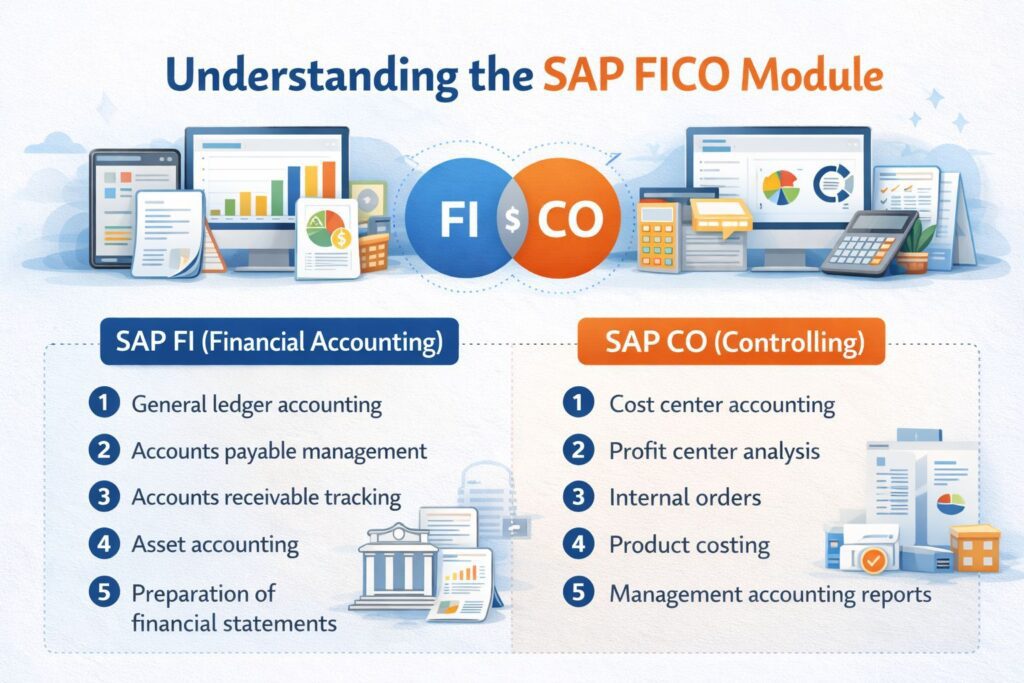
The SAP FICO module plays a key role in managing financial operations within an organization. It supports both external reporting and internal financial analysis, helping companies maintain transparency and control over their finances.
The module consists of two main components that work together to manage financial information.
SAP FI (Financial Accounting)
SAP FI focuses on maintaining accurate financial records that are required for official reporting. It records financial transactions and helps generate financial statements used by management and regulatory authorities.
Key functions include:
1. General ledger accounting
2. Accounts payable management
3. Accounts receivable tracking
4. Asset accounting
5. Preparation of financial statements
These features allow businesses to organize financial data and maintain accurate accounting records.
SAP CO (Controlling)
SAP CO focuses on internal financial management. It helps organizations monitor costs, track budgets, and improve financial decision-making.
Important functions include:
1. Cost center accounting
2. Profit center analysis
3. Internal orders
4. Product costing
5. Management accounting reports
Together, these components support financial accounting and controlling in an integrated ERP environment.
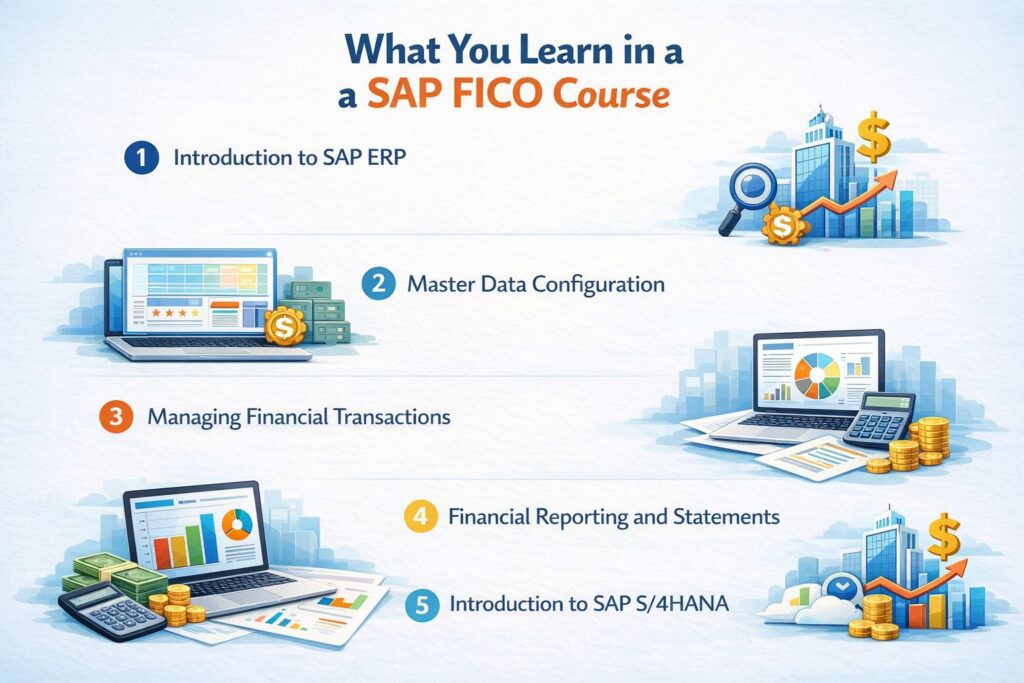
What You Learn in a SAP FICO Course
A well-structured SAP FICO course introduces learners to both accounting concepts and the technical functionality of the SAP system.
1. Introduction to SAP ERP
Students first understand how the SAP ERP platform connects finance with other business processes such as procurement, sales, and supply chain operations.
2. Master Data Configuration
One of the most important parts of SAP finance training is learning how to manage master data. Master data ensures that financial transactions are processed correctly.
Examples include:
- Company codes
- Chart of accounts
- Vendor and customer records
- Cost centers
- Profit centers
Proper configuration of master data is essential for accurate financial reporting.
3. Managing Financial Transactions
Learners also explore how accounting entries are created and processed in the SAP system. These transactions form the foundation for financial reporting and analysis.
4. Financial Reporting and Statements
Another important topic is the generation of financial statements and reports. These reports help organizations evaluate performance and monitor financial processes.
5. Introduction to SAP S/4HANA
Many modern training programs include an overview of SAP S/4HANA, the latest version of SAP ERP. This system improves performance by allowing businesses to process financial data and generate insights in real time.
Importance of Practical SAP FICO Course
When studying enterprise software, practical experience is extremely important. A quality SAP course should provide hands-on training so learners can practice using a real SAP environment.
Hands-on experience allows learners to:
- Work directly with the SAP system
- Configure financial settings
- Understand real business processes
- Practice financial transactions
- Analyze reports using real-time data
Practical exposure helps students gain confidence in working with SAP tools used by companies worldwide.
Who Should Enroll in a SAP FICO Course
A SAP FICO course is suitable for individuals who want to develop expertise in finance systems and ERP technology.
This training is especially useful for:
1. Commerce graduates
2. Accounting professionals
3. MBA students specializing in finance
4. Financial analysts and auditors
5. Professionals interested in ERP consulting roles
Even beginners with basic accounting knowledge can learn the fundamentals of SAP finance systems.

Career Opportunities After SAP FICO Training
Professionals who complete a SAP FICO course can explore several roles within organizations that use SAP ERP systems.
Common career options include:
- SAP FICO Consultant
- SAP Finance Analyst
- ERP Financial Consultant
- SAP Implementation Specialist
- Financial Systems Analyst
These roles involve managing financial processes, analyzing financial data, and supporting business operations through SAP technology.
Why Companies Use SAP for Financial Management
Organizations adopt SAP because it provides an integrated platform for managing financial activities and business processes.
Using SAP allows companies to:
- Maintain consistent financial records
- Integrate finance with other departments
- Generate financial reports quickly
- Monitor financial performance
- Support better decision-making with real-time information
These capabilities make SAP one of the most trusted ERP platforms for financial management.
Conclusion
A SAP FICO course helps learners understand how financial accounting and controlling operate within the SAP ERP environment. The training covers essential topics such as master data, financial reporting, management accounting, and business processes.
As more organizations adopt advanced ERP solutions like SAP S/4HANA, professionals with knowledge of SAP finance modules are increasingly valuable in the job market. For individuals interested in finance and enterprise technology, learning SAP FICO can provide a strong foundation for building a career in ERP systems.
FAQs
What is a SAP FICO course?
A SAP FICO course teaches how financial accounting and controlling functions are managed within the SAP ERP system.
Can beginners learn SAP FICO?
Yes. Beginners with a basic understanding of accounting can gradually learn SAP finance concepts and system functionality.
What is the difference between SAP FI and SAP CO?
SAP FI focuses on financial reporting and transaction management, while SAP CO deals with internal cost analysis and management accounting.
Is SAP FICO a good career option?
Yes. Many organizations use SAP ERP systems, which creates demand for professionals who understand financial processes within SAP.