
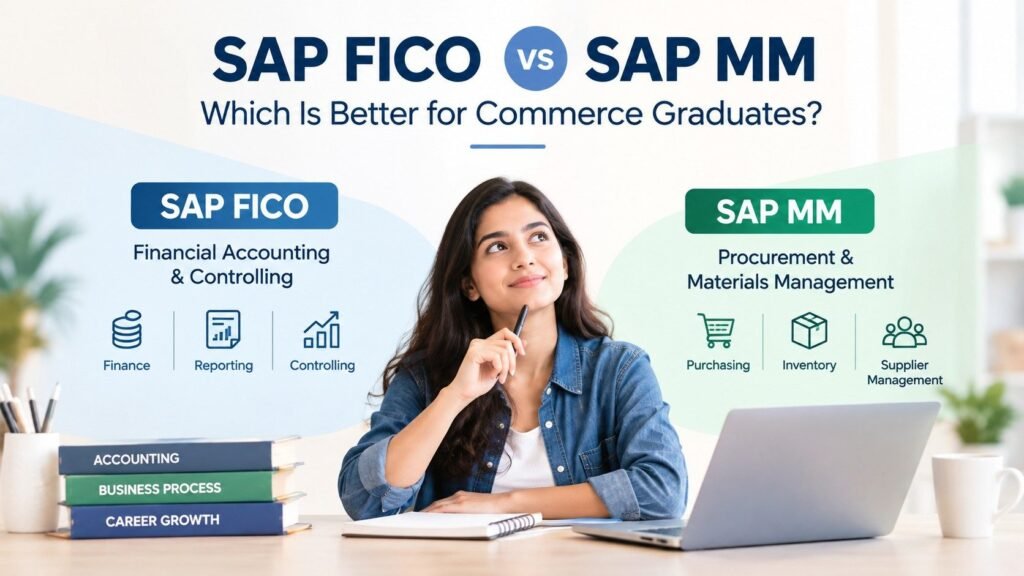
Introduction
Commerce graduates often explore professional courses that can help them build careers in accounting, finance, procurement, and business operations. SAP offers different modules for these areas, with SAP FICO and SAP MM being two popular options to consider. However, both modules serve different business functions. Understanding their responsibilities, required skills, and career pathways can help you select training that aligns with your educational background and interests. In this guide, we compare SAP FICO and SAP MM to help commerce graduates make an informed career decision.

What Is SAP FICO?
SAP FICO is a functional area of SAP ERP systems that combines Financial Accounting (FI) and Management Accounting (CO). It supports financial reporting, accounting processes, cost management, and internal financial analysis.
The FI component focuses on recording and reporting financial transactions, while CO supports internal cost tracking, planning, and management reporting.
Key areas covered in SAP FICO include:
– General ledger accounting
– Accounts payable and accounts receivable
– Asset accounting
– Financial statements and reporting
– Cost centres and internal orders
– Cost and profitability analysis
This module can be relevant for B.Com graduates, M.Com students, finance professionals, and accounting graduates who want to understand how financial processes operate within an integrated business system.
What Is SAP MM?
SAP MM stands for Materials Management. It supports procurement and inventory-related processes, helping businesses manage the purchasing and movement of materials.
The module connects purchasing activities with inventory management and other business functions. It is particularly relevant to organisations that manage suppliers, raw materials, finished goods, or large inventories.
Key areas covered in SAP MM include:
– Purchasing and procurement
– Vendor and supplier-related processes
– Material master data
– Inventory management
– Purchase orders and goods receipts
– Invoice verification and purchasing integration
Commerce graduates interested in supply chain operations, purchasing, vendor coordination, and inventory processes may find this module worth exploring.
SAP FICO vs SAP MM: Key Differences
Although both modules are used in business environments, their primary responsibilities differ.
Comparison factor SAP FICO SAP MM
Main focus Financial accounting and controlling Materials management and procurement
Core processes Accounting, reporting, cost management Purchasing, stock management, material movements
Useful background Accounting, finance, commerce Procurement, inventory, business operations
Typical activities Financial postings and reporting Purchase orders and inventory transactions
Important skills Accounting principles and analytical thinking Process coordination and attention to detail
Common career directions SAP FICO Consultant, Finance Systems Analyst SAP MM Consultant, Procurement Systems Analyst
Actual job titles and responsibilities vary by employer, experience, and project requirements.
Which SAP Module Is Better for Commerce Graduates?
There is no single module that is suitable for every commerce graduate. Your choice should depend on the type of work you enjoy and the skills you want to develop.
Choose SAP FICO if You Enjoy Accounting and Finance
SAP FICO may suit you if you are interested in financial statements, accounting entries, cost analysis, and financial reporting.
A background in commerce can provide a useful foundation because you may already understand concepts such as ledgers, journal entries, assets, liabilities, and financial transactions.
During training, you can build on this knowledge by learning how financial processes are configured and executed within an SAP environment.
Potential career directions include SAP FICO Consultant, SAP Finance Support Analyst, and Finance Systems Analyst, depending on your training and experience.
Choose SAP MM if You Enjoy Procurement and Operations
SAP MM may be more aligned with your interests if you prefer purchasing processes, supplier coordination, inventory control, and material planning.
For example, a manufacturing business needs to purchase raw materials, receive deliveries, maintain stock records, and verify supplier invoices. SAP MM supports several of these activities through integrated business processes.
Commerce graduates who enjoy operational problem-solving and understanding how businesses manage materials may find this pathway relevant.
Potential career directions include SAP MM Consultant, Procurement Analyst, and Materials Management Support Analyst.
Skills Required for Both SAP Modules
Before enrolling in a course, consider the practical skills each pathway involves.
For SAP FICO, focus on accounting fundamentals, financial reporting, cost concepts, spreadsheet skills, and analytical thinking.
For SAP MM, focus on procurement workflows, inventory concepts, purchasing documentation, supplier processes, and attention to detail.
Both modules also benefit from logical thinking, communication skills, process documentation, and the ability to understand business requirements.
Previous SAP experience is not always necessary for entry-level training, but employers may expect practical knowledge, project exposure, and a clear understanding of the relevant business processes.
Career Opportunities After SAP FICO or SAP MM Training
Both modules can lead to career opportunities in organisations that use SAP software. However, completing a course alone does not guarantee employment.
Employers may evaluate your understanding of business processes, hands-on system practice, problem-solving abilities, communication skills, and relevant work experience.
Beginners can strengthen their profiles by practising realistic business scenarios, learning how transactions flow through the system, and preparing to explain the purpose of each process.
When comparing training programmes, look for practical exercises, guided projects, experienced trainers, and career preparation support.
How to Choose the Right SAP Course
Use these questions to narrow down your options:
1. Do you enjoy accounting, financial statements, and cost analysis? Explore SAP FICO.
2. Are you more interested in purchasing, inventory, and supplier management? Explore SAP MM.
3. Does the course include practical system exercises and real-world scenarios?
4. Does the curriculum cover current SAP business processes relevant to your career goals?
5. Does the institute offer guidance on projects, interview preparation, and career development?
Review the course curriculum carefully before enrolling. A clear understanding of your interests and learning goals will help you make a more confident decision.

Conclusion
Choosing between SAP FICO and SAP MM depends on the business processes you want to work with. SAP FICO focuses on financial accounting and controlling, whereas SAP MM focuses on procurement and materials management. For commerce graduates, the most useful starting point is to identify whether finance-related work or supply chain operations better match their interests. Compare course content, practical learning opportunities, and career support before making a decision.