Introduction
Digital marketing is changing rapidly, and as a result, AI Tools for Digital Marketing are becoming an important part of modern marketing strategies. For example, from creating content and researching keywords to analyzing campaigns and improving customer engagement, artificial intelligence can help marketers work faster and make better decisions.
In 2026, marketers do not need to use AI to replace their creativity or strategy. Instead, the right AI tools can reduce repetitive work, generate ideas, analyze large amounts of data, and help marketing teams focus on activities that require human judgment.
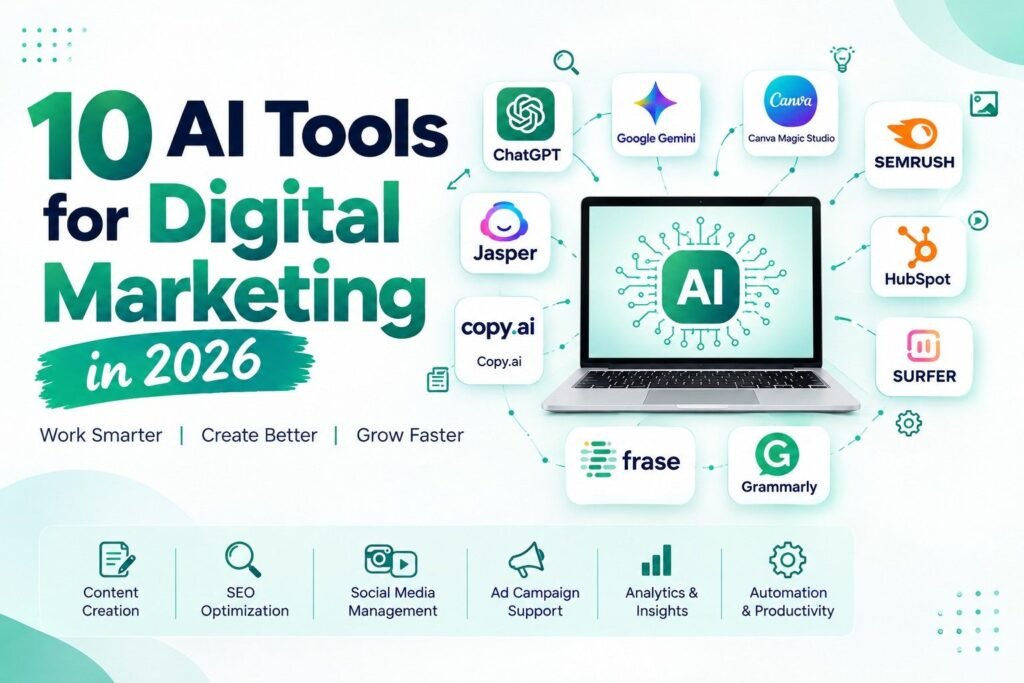
This guide covers 10 AI Tools for Digital Marketing, organized by their main uses, including content creation, SEO, social media, advertising, email marketing, analytics, design, and automation.

What Are AI Tools for Digital Marketing
AI Tools for Digital Marketing are software applications that use artificial intelligence, machine learning, natural language processing, data analysis, or generative AI to support marketing activities.
These tools can help marketers:
- Generate content ideas
- Write and improve marketing copy
- Research keywords
- Optimize SEO content
- Create images and videos
- Manage social media content
- Analyze marketing campaigns
- Create advertising variations
- Automate repetitive tasks
- Understand customer behavior
- Improve email campaigns
- Generate reports and insights
What Are AI Tools for Digital Marketing?
AI Tools for Digital Marketing are software applications that use artificial intelligence, machine learning, natural language processing, data analysis, or generative AI to support marketing activities. As a result, marketers can use these tools to complete several tasks more efficiently.
Some of the main benefits include:
1. Faster Content Creation
AI can help marketers brainstorm blog topics, create outlines, develop social media ideas, and draft marketing copy.
2. Better Productivity
Instead of spending hours on repetitive tasks, marketers can use AI to create first drafts, summarize information, organize data, and automate workflows.
3. SEO Support
AI-powered SEO platforms can help with keyword research, content optimization, competitor analysis, and identifying content opportunities.
4. Personalized Marketing
AI can analyze customer data and help marketers create more relevant messages for different audience segments.
5. Data-Driven Decisions
AI tools can process large amounts of information and help marketers identify patterns, trends, and campaign opportunities.
6. Faster Creative Testing
Marketers can create multiple versions of headlines, advertisements, images, and social media content and test which versions perform better.
According to recent marketing-tool guides, AI is increasingly being used across content creation, SEO, analytics, advertising, and customer engagement.
10 AI Tools for Digital Marketing in 2026
In 2026, marketers do not need to use AI to replace their creativity or strategy. Instead, the right AI tools can reduce repetitive work, generate ideas, analyze large amounts of data, and help marketing teams focus on activities that require human judgment. Therefore, AI works best as a support system rather than a replacement for human expertise.
Here are more than 10 tools worth exploring.
1. ChatGPT – Content, Research, and Marketing Ideas
ChatGPT can support marketers across many parts of the digital marketing process.
Marketers can use it for:
- Blog topic ideas
- Content outlines
- Social media captions
- Email drafts
- Ad copy ideas
- Customer persona
- development
- Keyword brainstorming
- Marketing strategy ideas
- Content repurposing
- Research assistance
The important point is to treat AI-generated information as a starting point. Marketing teams should review facts, brand tone, originality, and accuracy before publishing.
2. Google Gemini – Research and Content Assistance
Google Gemini can help marketers brainstorm ideas, summarize information, create drafts, and support research workflows.
It can be useful for marketers who already work within Google’s ecosystem and need AI assistance for research and content-related tasks.
3. Canva Magic Studio – AI Design
Canva’s AI features can help marketers create visual content without requiring advanced graphic-design skills.
Useful applications include:
- Social media graphics
- Presentations
- Marketing banners
- Ad creatives
- Images
- Visual content ideas
- Brand assets
Visual AI tools can be particularly useful for small businesses and marketing teams that need to produce creative assets quickly. Canva identifies content generation and visual creation as major AI applications in marketing.
4. Semrush – SEO and Marketing Intelligence
Semrush is widely used for SEO and digital marketing research. Its AI-powered features can support content creation, optimization, keyword research, competitor research, and visibility analysis.
Marketers can use platforms such as Semrush to identify:
- Keyword opportunities
- Competitor strategies
- Content gaps
- SEO performance
- Search trends
- Content optimization
- opportunities
Its current Content Toolkit also combines marketing data with AI-assisted content workflows.
5. Jasper – AI Content Marketing
Jasper is designed for marketing teams that need help creating and managing brand-focused content.
It can support:
- Blog content
- Advertising copy
- Social media content
- Email campaigns
- Marketing campaigns
- Brand messaging
It can be useful when businesses need consistent messaging across multiple marketing channels.
6. Copy.ai – Marketing Copy and Workflows
Copy.ai focuses heavily on marketing and sales-related content.
Marketers can use it to generate:
- Ad copy
- Email copy
- Social media content
- Product descriptions
- Marketing messages
- Content ideas
It can help teams speed up repetitive copywriting tasks while allowing marketers to edit the final output.
7. HubSpot AI – Marketing and CRM
HubSpot combines marketing, sales, customer relationship management, and AI features.
Its AI capabilities can support activities such as:
- Content creation
- Customer communication
- Marketing automation
- Campaign management
- CRM-related workflows
- Content optimization
AI content-generation tools are increasingly being integrated with publishing, workflow, and reporting systems rather than operating as standalone writing tools.
8. Surfer – AI-Powered Content Optimization
Surfer is focused on SEO content optimization.
It can help marketers analyze search results and optimize content around relevant topics and keywords.
It can be useful for:
- Content briefs
- On-page optimization
- Content scoring
- Keyword usage
- Competitive content analysis
9. Frase – SEO Content Research
Frase helps marketers research search results and create content briefs.
It can support the content workflow from research and outlining to optimization.
This makes it useful for marketers who want to create articles based on search intent rather than simply writing content around a keyword.
10. Grammarly – AI Writing Assistance
Grammarly can help marketers improve the quality and clarity of their writing.
It can identify issues related to:
- Grammar
- Spelling
- Sentence structure
- Tone
- Clarity
- Conciseness
For marketing teams, strong writing matters because unclear copy can reduce engagement and conversions.
How to Choose the Right AI Tools for Digital Marketing
With hundreds of AI products available, choosing the right tools can be difficult. Therefore, marketers should evaluate each tool carefully before adding it to their marketing stack.
Use these questions before adding a new tool to your marketing stack.
1. What problem does the tool solve?
Do not choose a tool simply because it is popular. Identify the specific marketing problem you want to solve.
2. Does it fit your workflow?
A tool should make your workflow easier rather than create additional complexity.
3. Does it provide useful output?
Test the quality before committing to a paid subscription.
4. Can you measure its impact?
Track whether the tool saves time, improves content quality, increases conversions, or reduces costs.
5. Does it protect your data?
Review the provider’s privacy and security policies before entering confidential business or customer information.
6. Does it require human review?
AI-generated content should be checked for accuracy, originality, brand voice, and relevance.
Are AI Tools Replacing Digital Marketers?
AI tools are changing digital marketing jobs; however, that does not mean human marketers are no longer needed. Instead, successful marketers still need skills such as strategy, communication, creativity, customer understanding, data analysis, SEO, advertising, brand management, and critical thinking. Therefore, the role of the digital marketer is increasingly becoming a combination of marketing expertise, data, technology, and AI.
Successful marketers still need skills such as:
- Strategy
- Communication
- Creativity
- Customer understanding
- Data analysis
- SEO
- Advertising
- Brand management
- Critical thinking
The role of the digital marketer is increasingly becoming a combination of marketing expertise + data + technology + AI.
How to Learn AI Tools for Digital Marketing
Learning dozens of AI tools at once is unnecessary. Instead, a better approach is to learn tools according to marketing functions. First, start with AI for content creation, SEO, social media, graphic design, advertising, analytics, and automation. Then, practice by creating real projects.
Start with:
- AI for content creation
- AI for SEO
- AI for social media
- AI for graphic design
- AI for advertising
- AI for analytics
- AI for automation
Then practice by creating real projects.
For example, create a complete campaign for a fictional business:
Keyword Research → Blog → SEO Optimization → Social Media → Google Ads → Meta Ads → Analytics → Report
This approach helps learners understand how individual AI tools fit into a complete digital marketing strategy.
Benefits of Learning AI Tools for Digital Marketing
Learning AI-powered marketing tools can help students and professionals:
- Work more efficiently
- Create content faster
- Improve research skills
- Understand modern
- marketing workflows
- Develop practical marketing projects
- Support SEO campaigns
- Create social media strategies
- Analyze campaign performance
- Improve employability
Conclusion
The digital marketing industry is changing rapidly, and AI tools are becoming useful for marketers in 2026. These technologies can support tasks such as creating content, researching keywords, managing social media, analyzing campaigns, generating ideas, and automating repetitive marketing activities.
At PS Academy, learners can understand how AI can be used alongside core digital marketing concepts. The goal is not to rely on every available AI platform, but to understand which tools suit specific marketing tasks and how to use them effectively.
Students, freshers, freelancers, and working professionals can develop practical knowledge in areas such as SEO, social media marketing, content marketing, Google Ads, lead generation, analytics, and automation while exploring relevant AI solutions.
AI can make marketing workflows faster, but human creativity, strategic thinking, audience understanding, and decision-making remain important. Combining these skills with AI knowledge can help learners prepare for changing digital marketing roles.
PS Academy focuses on practical digital marketing learning, helping students understand modern tools and apply their knowledge through real projects and industry-focused activities